
Multi-Day Research Programs
Our student-driven research programs teach the process of science through the creation of a field research project. By studying locations near your school campus, students strengthen their connection to the ecosystems in your community. In addition to delivering increased academic confidence, better social skills, and building science and language skills, all of our programs are designed to meet NGSS SEPs and content, and NGSS DCIs in a fun and engaging way.
Overview
Our programs offer a high-level, inquiry-based science research experience in a flexible setting.
Cost: Programs cost $200 per student for a 5-day program. Multiple class volume discounts are available. Financial aid is available to low-income schools.
Sample Schedule
This is a sample schedule that lays out a full research Project. We can do shorter programs that only includes some parts of the project such as: scientific question asking, scientific literacy, and in introduction to field methods.
Day 1: Question Asking
First, students are split into collaborative groups and are guided through writing a testable research question and hypothesis. Next, students use peer-reviewed scientific papers as evidence to support their claims. All groups will leave the session with a refined version of their research question and hypothesis.
SEPs: Asking questions and defining problems. Planning and carrying out investigations. Obtaining, evaluating, and communicating information.
Day 2: Methods Development
Students develop a research proposal. The proposal guides students through method development. Afterward, students will construct a well thought out investigation for utilization in the field.
SEPs: Developing and using models. Planning and carrying out investigations. Constructing explanations and designing solutions.
Day 3: Field Day
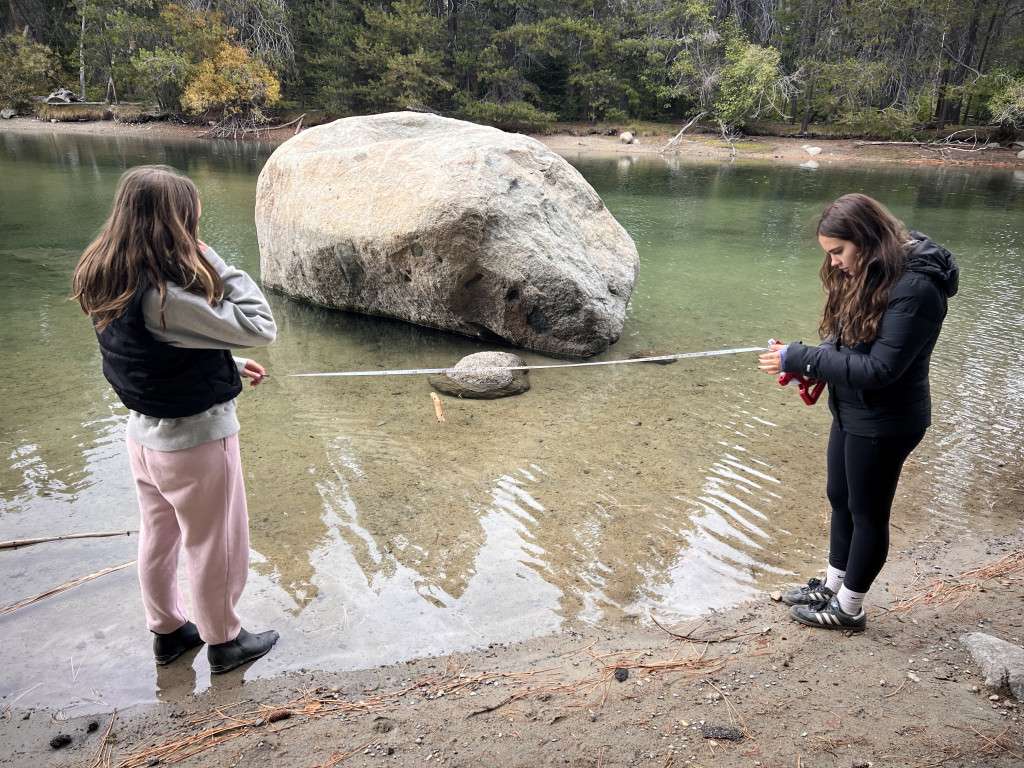
This is an all day or ½ day activity. Students collect data at a field site near your school or on location in the Tahoe area. During this session, students are guided through field techniques and data collection. Then they will implement their research proposals to collect and analyze unique data sets.
*Students bring their own lunch, snacks, and water.*
SEPs: Planning and carrying out investigations. Obtaining, evaluating, and communicating information. Analyzing and interpreting data.
Day 4: Analyzing and Interpreting Data
In this session, students analyze and graph their data. Afterward, a facilitated student discussion reviews the implications of their findings and construction of their scientific presentations begins. In addition, a digital office hour is provided after school hours as additional support for this process.
SEPs: Analyzing and interpreting data. Using mathematics and computational thinking. Obtaining, evaluating, and communicating information.
Day 5: Student Presentation Day
During student presentation day, we livestream and record the presentations to be posted on YouTube (public or private) to share with the school and parents. Each presentation will be followed by a short Q&A session from their classmates. Finally, students take the Headwaters post-program survey (about 10 minutes).
SEPs: Engaging in argument from evidence. Obtaining, evaluating, and communicating information.
Parent Night
We encourage you to host the optional capstone for this project at your school: a parent night where students can present their research. This evening is essential in bridging the gap between student learning and parent involvement.

The Parent Night Structure:
The parent night takes place at your school in the evening sometime after the final class period. Students and parents gather in a school classroom, cafeteria, or auditorium. Following a short introduction by the school and a Headwaters instructor, the students present individually to their parents kiosk-style, as they mingle around the room, like a science fair. (If you have small numbers you can have them give their talk to the whole audience).
In addition, we create question cards to hand out to the parents, so they have some ideas of what to ask the students about their projects as they watch the presentations.
If an in person parent night doesn’t work, we can live steam and record the students presentations during class so parents can login and the recording can be distributed to parents and students/school.
Program Topics
High School
Headwaters’ programs are a great way to challenge your high school and A.P. students. Whether it is at our Donner Summit Field Site or a location closer to your school, our instructors can help you find an engaging natural system for students to conduct original research projects around. All of our programs challenge students to apply fundamental science skills to real-world scenarios through the process of scientific research. All programs give students experience using all of the fundamental science skills laid out in the NGSS Science and Engineering Practices (SEPs) as well as several NGSS Cross Cutting Concepts. Below is a list of recommended topics by subject area.
Ecosystem dynamics
NGSS Corresponding Content: HS. Interdependent Relationships in Ecosystems and HS.Natural Selection and Evolution
- How can we quantify habitat value and measure the effect this has on population size and biodiversity? (for plant, insect, and bird populations)
- Why is it that wetlands are biodiversity hotspots and provide key ecosystem services?
- How does riparian morphology affect water quality and the organisms living around the riparian corridor?
- How does forest structure and composition affect susceptibility to parasites such as parasitic Dwarf Mistletoe in Sierra conifers?
- How can changes to an ecosystem cause shifts in the natural selection pressures on plants and insects?
- Seasonally dependent – What factors affect the timing of plant development and how could climate change affect these systems?
- Recommended only for overnight programs – What factors affect nutrient cycling of nitrogen, phosphorus, and potassium levels in soil?
Human impacts
NGSS Corresponding Content: Human Sustainability
- How do human development and invasive species affect biodiversity and habitat quality in urban areas?
- How does human activity affect turbidity and salinity in waterways? What impact does this nonpoint-source pollution have on the ecosystem?
Biodiversity and Bioassessment
NGSS Corresponding Content: Interdependent Relationships in Ecosystem
APES Corresponding Content: Unit 1: The Living World: Ecosystems, Unit 2: The Living World: Biodiversity
- What biotic and abiotic factors affect the plant, insect, and bird biodiversity around the field site?
- How can benthic macroinvertebrate and riparian bioassessments be used to monitor and design solutions to promote healthy waterways?
Environmental Chemistry
NGSS Corresponding Content: Matter and Energy in Ecosystems
APES Corresponding Content: Unit 1: The Living World: Ecosystems, Unit 8: Aquatic and Terrestrial Pollution.
- What factors drive changes in total dissolved solids, pH, nitrogen and phosphorus species in the waterways and wetlands?
- Recommended only for overnight programs – What factors affect nutrient cycling of nitrogen, phosphorus, and potassium levels in soil?
Human Impacts
NGSS Corresponding Content: Human Sustainability and/or Earth and Human Activity
APES Corresponding Content: Unit 2: The Living World: Biodiversity, Unit 9: Global Change
- How does human activity affect water quality in waterways? What impact does this nonpoint-source pollution have on the ecosystem?
- How have human-driven abiotic (development) and biotic (invasive species) changes shaped habitats in urban areas?
Snow Science
NGSS Corresponding Content: Earth and Human Activity
APES Corresponding Content: Unit 5: Land and Water Use, Unit 9: Global Change
- Snow and Water Availability – How does the structure (temperature, crystal shape, and density) of the Sierra snowpack affect water availability in the state?
- Snow Melt Mechanics – How do albedo, aspect, and forest density affect rates of snowmelt?
- How does human activity affect snowmelt rates and runoff water quality in the Sierra?
Chemistry
- Water Chemistry – What factors drive changes in total dissolved solids, pH, hardness, and nitrogen species in the waterways and wetlands?
- Aquatic Nutrient Cycling – How do human, plant, and animal activities impact phosphate and different nitrogen species concentrations in waterways?
- Soil nutrient cycling – Recommended only for overnight programs – What factors affect nutrient cycling and availability of nitrogen, phosphorus, and potassium levels in soil?
- Rates of reactions – PS1.B: Chemical Reactions – How does temperature and/or anaerobic conditions affect rates of reactions in natural systems?
Middle School
Middle school is a great time to expose your students to the scientific process through conducting original scientific research. We offer overnight and at school programs for middle schools. All programs give students experience using all of the fundamental science skills laid out in the NGSS Science and Engineering Practices (SEPs) as well as several NGSS Cross Cutting Concepts. Below is a list of recommended topics by subject area.
Life Science
NGSS corresponding content: MS.Matter and Energy in Organisms and Ecosystems and/or MS.Interdependent Relationships in Ecosystems
- Populations and Resources:
- How does the abundance of biotic and abiotic resources affect the plant, insect, and bird populations?
- How do organisms compete for limited resources and use ecological niches to survive?
- What factors affect insect biodiversity and population size?
- Ecosystems and Human Impacts:
- How do the biotic and abiotic (water quality, substrate, and hydrology) components of an ecosystem affect ecosystem services (habitat, water filtration, and erosion prevention)?
- How have human-driven abiotic (development) and biotic (invasive species) changes shaped habitats in urban areas?
- How can we use riparian bioassessments to monitor and design solutions that promote ecosystem health?
Weather
NGSS corresponding content: MS Weather and Climate and/or MS Earth’s Systems
- Differential heating and circulation patterns: ESS2.C: The Roles of Water in Earth’s Surface Processes and ESS2.D: Weather and Climate
- Uneven heating of earth surfaces – How do different surfaces absorb heat differently causing changes to local air temperature?
- Ocean Current Circulation – What factors cause ocean currents to move and what impact does this have on global weather patterns?
- Air circulation patterns – How do differences in atmospheric pressure affect local weather?
Earth Science
NGSS corresponding content: Earth’s Systems
- Erosion and Sedimentation:
- What factors affect rates of erosion and sedimentation around the field site?
Request Program Consultation
Currently booking for Fall 2026 and beyond — reach out anytime to check availability.
Headwaters Science Institute is a 501(c)3 nonprofit corporation
Website Developed by TheMikeBarra


