
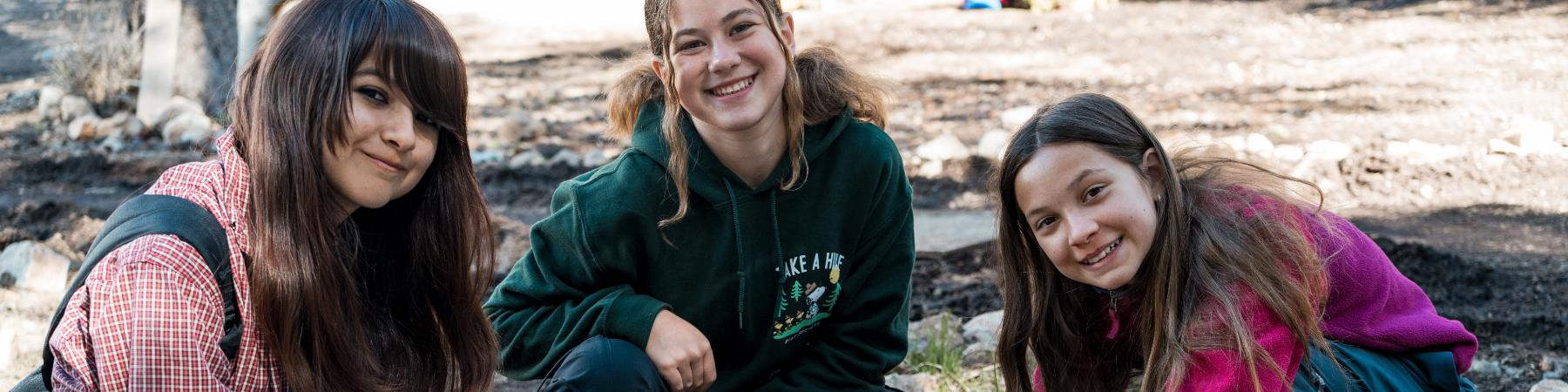
Field Days
Our student-driven field day research programs engage elementary through high school students in individual steps of the scientific method. Headwaters will host students for a field day near your school or at our field sites in the Lake Tahoe area to allow them to strengthen their connection to the ecosystems around them. In addition to delivering increased academic confidence, better social skills, and building science and language skills, all of our programs give students experience using all of the fundamental science skills laid out in the NGSS Science and Engineering Practices (SEPs) as well as several NGSS Cross Cutting Concepts.
Field Days are $100 per student for 20 or more students. Multiple class volume discounts are available. Financial aid is available to low-income schools.
Overview
Program Overview
We offer customizable field day programs for elementary through high school students to explore hands-on science outside of the classroom. We can adapt this program to match any of your existing units, or you can choose from our list of topics. Previous topics include:
Environmental Science
Ecology
Coastal Ecology
Biodiversity
Animal/Insect Behavior
Water Quality & Aquatic Ecosystems
Human Impact
Geology & Erosion
Environmental Chemistry
Horticulture & Plant Science
Pollination and Reproduction
Soil Health
Ecosystem Dynamics
Snow & Winter Climate
Fire Science
And MORE!
We are happy to work with you to make this program a perfect fit for your students! In addition, all Headwaters programs are customized to align with selected Next Generation Science Standards and Science and Engineering Practices.
Middle School Standards
MS-ESS3-2: Analyze and interpret data on natural hazards to forecast future catastrophic events and inform the development of technologies to mitigate their effects.
MS-ESS3-3: Apply scientific principles to design a method for monitoring and minimizing a human impact on the environment.
MS-ESS3-4: Construct an argument supported by evidence for how increases in human population and per-capita consumption of natural resources impact Earth’s systems.
High School Standards
HS-LS2-7: Design, evaluate, and refine a solution for reducing the impacts of human activities on the environment and biodiversity.
HS-ESS3-1: Construct an explanation based on evidence for how the availability of natural resources, occurrence of natural hazards, and changes in climate have influenced human activity.
HS-ESS 3-3: Create a computational simulation to illustrate the relationship among the management of natural resources, the sustainability of human populations, and biodiversity.
HS-ESS 3-4: Evaluate or refine a technological solution that reduces the impacts of human activities on natural systems.
Sample Schedule
15 minutes: Welcome and meet mentors
1 hour: Introduction to Scientific tools and method development:
Students rotate through stations to introduce students to science field techniques. Students will practice using the tools to collect data
SEPs: Developing and using models. Planning and carrying out investigations. Constructing explanations and designing solutions.
1 hour: Introduction to science research
The students use what they learned about the field tools and basic data collection to make testable questions. Students are guided through writing a testable research question and hypothesis. Then, they will develop basic methods to test their hypothesis.
SEPs: Asking questions and defining problems. Planning and carrying out investigations. Obtaining, evaluating, and communicating information.
3 hours: Data Collection:
Students are guided through field techniques and data collection. They are then split into small groups to collect data.
SEPs: Planning and carrying out investigations. Obtaining, evaluating, and communicating information. Analyzing and interpreting data.
1 hour: Data Synthesis: Students will end the day by making a basic hand drawing of their data. Our scientist mentors facilitate a student discussion about their findings and what their results mean.
SEPs: Analyzing and interpreting data. Using mathematics and computational thinking. Obtaining, evaluating, and communicating information.


